
By Dr. Yatisha Blythe
Imagine navigating housing instability, adjusting to new caregivers, and managing the emotional toll of reunification uncertainty— in tandem with keeping up with a new school setting, teachers, classmates, and expectations. For students residing in foster care placements, this is not an occasional challenge but a regular reality. Every child or youth can benefit from a secure and stable home environment; it helps them focus on learning, complete homework assignments, and develop daily routines. This is much harder to accomplish when life and housing stability feels unpredictable. Ensuring that the educational needs of children and youth in foster care are met is not only a moral imperative, but also a legal mandate that profoundly shapes long-term life outcomes.
Educational Landscape
Students in foster care are more likely than their peers to experience educational challenges and may even fall behind in their academic progression. Housing instability due to frequent placement changes and multiple school moves each year can directly affect their learning. Some students enter care already behind academically due to previous trauma, inconsistent schooling, or unmet learning needs. Research consistently shows that youth in care graduate at significantly lower rates than their peers and face higher risks of course failure, chronic absenteeism, and disciplinary exclusion.
- Nationally, 69%–85% of foster care students earned a high school diploma or GED in 2024, compared to 95% of students overall.
- In the 2024–2025 school year, 60.4% of North Carolina’s foster care students graduated high school on time with their 2021–2022 original ninth-grade cohort – this reflects a five-point increase from the previous school year, and a three-point increase over the span of four years (2021-2025).
Graduation rates of students in foster care are not a result of students’ inability to learn but rather reflect the existence of systemic barriers that must be addressed by educators, child welfare practitioners, and foster parents to intentionally support the unmet academic and socio-emotional needs of students placed in the foster care system.
Federal Laws
On December 10, 2015, US Congress signed into law the Every Student Succeeds Act (ESSA), reauthorizing the Elementary and Secondary Education Act (ESEA) of 1965 and establishing distinct provisions for children and youth in foster care under Title I, Part A (Title I). These provisions complemented the requirements of the Fostering Connections to Success and Increasing Adoptions Act of 2008 (Fostering Connections Act) and further promote the purpose of Title I – to ensure that all children receive a high-quality education and to close achievement gaps between student groups. Together these laws strengthen opportunities for education and child welfare agencies to jointly determine the most effective practices to remove enrollment barriers and promote school stability and success for students.
This joint decision making ensures that students in foster care can access a well-rounded education and have an opportunity to achieve academic success at the same level as their peers. The ESSA provisions promote educational stability for students by keeping those entering the foster care system—or those changing foster placements—enrolled in their school of origin, unless it is determined to be in their best interest to change schools. Additionally, if it’s not in a student’s best interest to remain in their school of origin, the student should be enrolled in a new school without delay. This kind of stability means that students can stay engaged in their coursework, keep important relationships intact, and build towards high school graduation and future college or career opportunities.
The ESSA includes specific provisions to maintain educational stability and support the unique needs of students in foster care:
- Best Interest Determinations (BIDs) – students may continue attending their school of origin throughout their time in foster care, unless a BID indicates otherwise. BIDs must consider the educational setting and proximity to the school during placement, along with factors like student and parent preferences, school attachment, permanency goal, and other relevant academic and socio-emotional factors.
- School of Origin Transportation –students may receive transportation to their school of origin when necessary, and schools are encouraged to continue this support through the end of the school year after a student exits foster care. School districts must work with child welfare agencies to develop and implement clear written procedures outlining how transportation will be provided, arranged, and funded to keep students in their schools of origin throughout their time in foster care.
- Immediate Enrollment – students must be enrolled immediately in the school determined to be in their best interest. The 2024 Non-Regulatory Guidance: Ensuring Educational Stability for Children in Foster Care defines “immediate” to mean as soon as practicable – typically within three business days.
- Dispute Resolution – students must remain in their school of origin while disputes are being resolved. If you have questions about the dispute resolution process, please visit the North Carolina Foster Care Education Program Website to access the state directory for local education POCs.
- Academic Success – students may belong to multiple subgroups and must have access to cross-program supports such as special education, English Learner services, CTE, juvenile justice, homeless education, and other relevant programs. School districts must revise policies to eliminate barriers for students in foster care – especially in attendance, discipline, and earning credits toward graduation.
What Every Foster Parent Should Know
1. Center The Voice of Your Child or Youth
Children and youth in foster care consistently express that they want to feel heard, supported, and believed in. They have often described school as the space where they felt the most normal and valued. Foster parents should incorporate their student’s perspectives into decision-making, and when appropriate, involve them in the BID process. Sharing their strengths and resilience shifts the narrative away from deficits, highlighting student’s courage, adaptability, and determination to their educational journey.
2. Understand the BID Process for School Stability
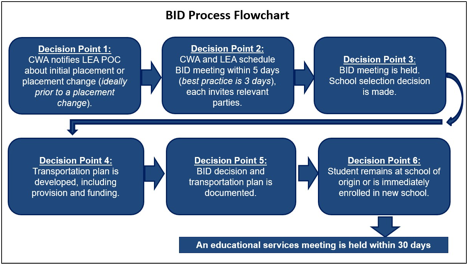
ESSA emphasizes strong collaboration between child welfare and education agencies to support educational stability for students in foster care. It’s important for foster parents to know that schools are often unaware of a child’s custody status and cannot begin ESSA-required steps until the child welfare agency (CWA) notifies the school district’s point of contact (POC) to initiate the BID process (see the flowchart below).
3. Learn Your Student’s Rights and Leverage Available School Supports
- Title I: Students in foster care are eligible to receive Title I services on the same basis as other students who attend a Title I school, they are also categorically eligible for free meals. Schools districts offering public preschool education must adhere to the Title I educational stability provisions; a child in foster care must remain in their preschool of origin unless it is not in their best interest.
- Additional Supports: Students are eligible for fee waivers (i.e., ACT/SAT testing, AP exam fees/fee reductions, college applications, etc.), tutoring, credit recovery programs, individualized learning plans, and access to rigorous coursework to help students catch up and thrive academically. Schools must also ensure that special education and related services follow the student through transitions.
4. Participate in Cross-System Communication
Regular communication among CWA caseworkers, school-based POCs, foster parents, and service providers ensures that student’s needs are quickly identified and addressed. Open communication, data sharing agreements, and timely notifications can help schools respond without delay.
Why Foster Parent Support Matters
Children and youth succeed when they feel connected. When they have a stable, supportive home environment this has a profound impact and students are more likely to stay on track academically, graduate high school, pursue postsecondary education, and develop the confidence to navigate adulthood. Education is one of the strongest predictors of long-term success, influencing employment, health, housing stability, and overall well-being. Meeting students educational needs is not simply a legal obligation – it’s an opportunity to change trajectories and open doors.
Conclusion
Students in foster care deserve an educational experience that affirms their potential, respects their resilience, and provides the stability they need to thrive. By working together across systems, we can ensure that every young person, regardless of their circumstances, has the opportunity to succeed in school and beyond.
Dr. Yatisha Blythe is the State Coordinator for the Foster Care Education Program at the NC Department of Public Instruction